

Wall Bearing: Safe Load-Bearing Wall Removal in Atlanta Homes
Introduction: Who This Guide Is For and Why It Matters
This guide is for Atlanta homeowners considering removing a wall to create an open-concept space. Understanding wall bearing is crucial to ensure your home's safety, maintain its value, and navigate the unique structural challenges found in Atlanta's older and historic homes. Removing a load-bearing wall is not just a matter of demolition—it’s an engineering task that, if done incorrectly, can lead to serious structural issues. Atlanta’s diverse housing stock, from 1920s bungalows to 1970s colonials, presents unique challenges that require professional assessment and expertise.
Key Takeaways
A wall bearing (load-bearing) wall carries the weight of your roof, floors, and structure down to the foundation—removing one is an engineering task, not simple demolition.
Heide Contracting specializes in structurally engineered wall removal in Atlanta’s older and historic homes, frequently taking over projects started incorrectly by other contractors.
The safe process involves analyzing how loads travel through your home, installing temporary shoring, then adding properly sized beams (often steel) to replace the wall’s structural role.
Atlanta’s housing stock—from 1920s bungalows to 1970s colonials—presents unique challenges including irregular framing, prior renovations, and hidden bearing conditions that require professional assessment.
Homeowners can schedule a free, closed-scope quote with Heide Contracting to get clear answers, real numbers, and a safe open-concept solution for their specific situation.
What Is a Wall Bearing (Load-Bearing) Wall?
A load bearing wall is a structural wall that carries the weight of floors, the roof, and sometimes other walls above it, transferring those loads downward through the building’s framework to the foundation. Unlike partition walls that simply divide rooms, these structural walls are essential components of your home’s skeleton. Removing one without proper planning can lead to sagging floors, cracked ceilings, or in worst cases, catastrophic structural failure.
Non-Load-Bearing Walls: What Are They?
Non-load-bearing walls are just partitions and do not support any portion of the building or structure except the weight of the wall itself. These walls can be removed or altered without affecting the structural integrity of your home, but load-bearing walls are critical structural elements that cannot be removed without compromising the building.
Wall-Bearing vs. Frame Structures
In wall-bearing structures, walls carry the roof and floor weight, while in frame structures, columns and beams do.
Types of Load-Bearing Walls in Atlanta Homes
In Atlanta houses, you’ll typically encounter several types of construction. Interior bearing walls are often wood-framed with 2x4 or 2x6 studs. Exterior walls frequently consist of brick veneer over wood framing, solid brick, or concrete block. Mid-century and renovated homes may include steel posts or beams that have been added over the decades. The material matters because it affects how the wall carries weight and what’s required to safely replace it.
How Load Paths Work
These walls function as part of a continuous “load path” from your roof down to the soil beneath your foundation. When you look at a single wall, you’re actually seeing one link in a chain that includes:
Roof rafters or trusses above
Ceiling joists and floor joists
Beams and girders below the floor
Foundation walls or footings at ground level
In platform-framed homes—the most common construction method in Atlanta—load-bearing walls typically sit directly over beams, girders, or thickened foundation areas. The wall’s top and bottom plates tie the vertical framing together, creating a unified structural element that transfers vertical loads efficiently. If floor or roof joists run parallel to a wall, that wall is typically non-load-bearing, though there are exceptions depending on the overall framing design.
Modern open-concept layouts often require replacing part or all of a load bearing wall with a properly engineered beam rather than simply “taking out the wall.” This is where many homeowners and contractors run into trouble. The wall isn’t just blocking your sightline to the kitchen—it’s holding up your house.
Why Load-Bearing Walls Matter in Atlanta’s Older and Historic Homes
Atlanta’s residential landscape tells a story through its architecture. From 1920s Craftsman bungalows in Candler Park to 1940s-1960s brick ranches in Brookhaven, from 1970s-1980s two-story colonials in Dunwoody to historic in-town Victorians, each era brought different construction methods and structural approaches. Understanding wall bearing behavior in these homes requires recognizing what makes them unique.
Unique Challenges in Older Atlanta Homes
Older homes present challenges that newer construction simply doesn’t have. Original framing may be irregular, with lumber sizes that don’t match modern standards. Beams that met building codes in 1950 may be undersized by today’s requirements. Perhaps most problematic: multiple generations of unpermitted renovations may have fundamentally changed how walls bear loads without leaving any documentation.
Common Atlanta Renovation Impacts on Wall Bearing
Table: Common Atlanta Renovation Impacts on Wall Bearing
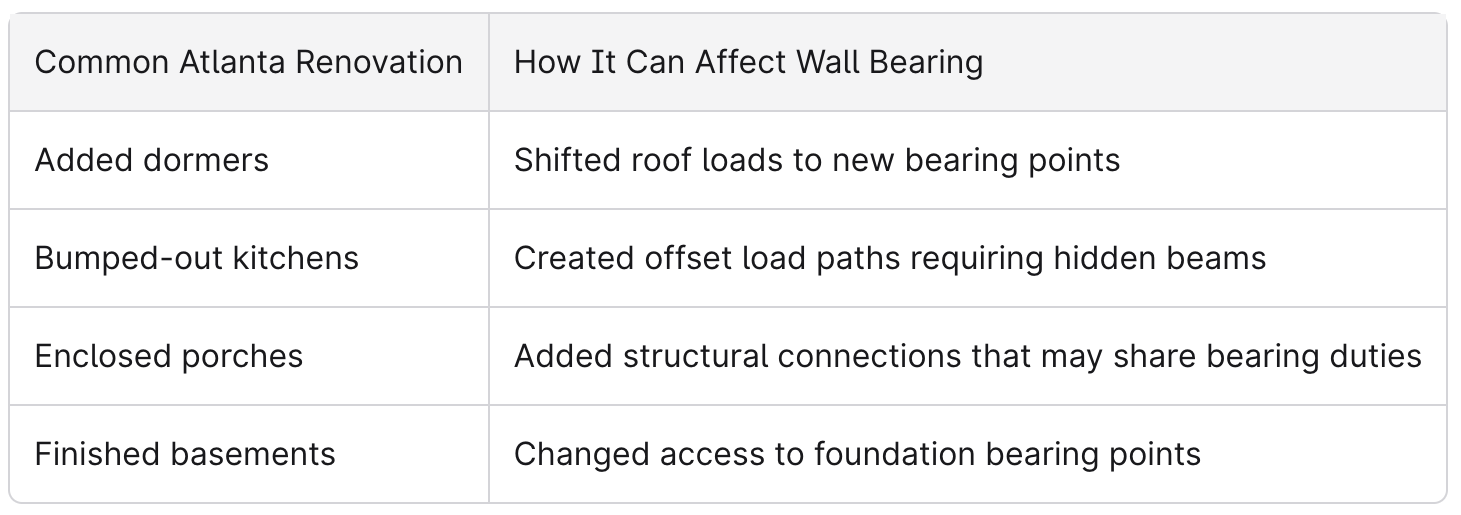
These alterations mean that simple “rules of thumb” for identifying bearing walls become unreliable. A wall that runs perpendicular to the joists should be bearing, right? Not necessarily—not if the previous owner installed a beam above the ceiling and moved the load path without updating any plans.
Note: In historic homes, visual clues alone are not sufficient to determine wall bearing status. Always consult a structural professional, as hidden modifications and irregularities can make assumptions based on appearance highly unreliable.
Hidden Structural Support in Atlanta Homes
Atlanta homes also feature construction elements that can hide where the structure is truly supported. Crawl spaces may contain multiple bearing lines with girders added over time. Stacked additions create complex load relationships between floors. Brick veneer can look like structural masonry from the outside while actually being a decorative outer wall supported by hidden wood framing.
Preserving historic character while reworking wall bearing elements demands surgical precision. Original trim, plaster, cased openings, and hardwood floors can easily be damaged by careless structural work. Engineering-led planning protects both the structural integrity and the period details that give these homes their value.
How Heide Contracting Approaches Wall Bearing Analysis
At Heide Contracting, we treat wall removal as an engineering decision first and a demolition task second. This distinction matters because the consequences of getting it wrong extend far beyond the immediate project—they can affect your home’s safety and value for decades.
Our Diagnostic Process
Our diagnostic process begins before anyone picks up a hammer:
Document Review
Examine available original blueprints and building plans
Review any previous engineering reports or renovation documentation
Check permit history with local jurisdictions
On-Site Investigation
Trace load paths from the roof through the attic down to the foundation
Identify joist direction on each floor
Inspect crawl spaces and basements for girders, columns, and bearing points
Examine attic framing for ridge beams, collar ties, and rafter bearing
Physical Assessment
Lift insulation to verify joist configuration and spacing
Identify beams and bearing lines hidden behind finishes
Measure spans and calculate tributary areas
Look for deflection, previous sagging, or signs of structural stress
Engineering Calculations and Scope
We don’t rely on visual clues alone. A structural engineer—either in-house or through our established partnerships—calculates the actual loads the wall is carrying and sizes replacement beams accordingly. These calculations consider span length, the tributary area being supported, and current building codes. In addition to vertical loads, lateral loads such as wind or seismic forces may also be analyzed to ensure the wall's removal does not compromise the building's stability.
The result is a clear, itemized scope that shows exactly how the wall bearing role is being replaced:
Demolition and debris removal
Temporary shoring design and installation
Beam specification (often LVL or steel)
Post and column locations
Footing upgrades if required
Drywall, trim, and finish repairs
You see every component of the solution before work begins—no surprises, no vague allowances.
Common Signs a Wall Is Bearing Load (and Why They’re Not Enough Alone)
Visual clues can suggest wall bearing status, but only comprehensive analysis confirms it. This distinction becomes critical in homes with complex histories or multiple renovations.
Typical Indicators That Suggest a Wall May Be Load-Bearing
Wall runs perpendicular to floor joists above
Wall aligns vertically with a beam, wall, or foundation element below
Substantial header exists over doors or large openings
Wall is located near the center of the house or along the first floor
Wall is thicker than surrounding partition walls
Wall is constructed from masonry walls, reinforced concrete, or timber framing rather than simple drywall on metal studs
Atlanta-Specific Examples: See how Heide Contracting revitalizes outdoor spaces in Atlanta with structural deck repairs.
In many Atlanta homes, the central wall running the length of the house sits directly over a main crawl space girder. Mid-century ranches often have walls bearing on steel I-beams that were added during original construction or later renovations. Walls integrated with masonry chimneys frequently carry structural loads, especially in homes where the chimney also supports floor joists.
Why These Clues Can Mislead
Hidden beams buried in ceiling framing can carry loads you don’t see. Previous renovations may have created offset bearing lines that don’t align logically. Converted porches often have structural elements that aren’t obvious from inside the living space. Prior changes may have broken the original load path entirely, redistributing weight to walls that weren’t designed for it.
The height to thickness ratio of a wall, the presence of columns nearby, and the direction of framing above all provide data points. But none of them replace the calculations a structural engineer performs to determine what’s actually happening.
If you’re considering removing a wall, these indicators can help you start the conversation. Alternatively, you might explore crawl space to basement conversions as a modern method for gaining living space while maintaining your home's character. Final decisions on removal and beam sizing must come from qualified structural professionals who can assess your specific conditions.
Exterior Walls: Special Considerations in Atlanta Homes
Exterior walls in Atlanta homes play a crucial role in maintaining the structural integrity of the entire building. Unlike interior partition walls, exterior walls are often designed as load bearing walls, meaning they support the weight of the roof, upper structure, and sometimes even additional floors, transferring these loads safely down to the foundation. This is especially important in Atlanta, where the region’s clay-rich soil and humid climate can impact how a building settles and how well it withstands seasonal changes.
How to Identify Load-Bearing Exterior Walls
When evaluating whether an exterior wall is load bearing or non load bearing, several factors come into play. The wall structure itself—whether constructed from wood framing, reinforced concrete, or masonry—affects its ability to distribute loads. For example, a solid brick or concrete wall with a low height to thickness ratio is more likely to be a bearing wall, designed to support significant weight. In contrast, a lightweight wood-framed wall with exterior cladding may be non load bearing, serving primarily as a weather barrier rather than a structural element.
Material choice is another key consideration. Masonry walls and reinforced concrete are commonly used for their strength and durability, especially in older Atlanta homes. These materials are well-suited to carry vertical loads from the roof and upper floors, but their removal or modification requires careful planning to avoid compromising the building’s support system. Wood-framed exterior walls, while still capable of bearing loads, may have different structural requirements and are often easier to modify—provided their role in the overall structure is clearly understood.
To determine if an exterior wall is load bearing, professionals assess the wall’s thickness, the materials used, and its position relative to the rest of the structure. They also consider the height to thickness ratio, as thicker walls are generally designed to support more weight. Examining original building plans or blueprints can provide valuable insight into the intended function of each wall, helping to identify which exterior walls are load bearing and which are not.
Ultimately, any changes to exterior walls—whether for new openings, additions, or complete removal—should be approached with caution. Proper assessment ensures that the loads from the roof and upper structure continue to be safely supported, preserving the stability and safety of your Atlanta home.
Masonry Walls and Their Unique Removal Challenges
Masonry walls are a common feature in many of Atlanta’s older homes, prized for their durability and classic appearance. However, when it comes to renovation, these walls present unique challenges—especially if they are load bearing. Constructed from materials like brick, stone, or concrete blocks, masonry walls can serve as critical structural elements, supporting roof loads, floor joists, and even other walls above.
The Risks of Removing Load-Bearing Masonry Walls
The removal of a load bearing masonry wall is a complex process that requires careful planning and expert oversight. Unlike non load bearing walls, which can often be removed with minimal risk, bearing walls are integral to the building’s ability to distribute loads safely to the foundation. Improper removal can result in structural damage, including sagging floors, cracked ceilings, or even partial collapse. This is why consulting a structural engineer is essential before any work begins—they can determine the wall’s role in the overall structure, calculate the loads it supports, and design a safe method for removal or replacement.
Non-Load-Bearing Masonry Walls: Demolition Considerations
Even non load bearing masonry walls require attention during demolition. While they may not support the weight of the roof or upper floors, they are often tied into adjacent structural members, and careless removal can damage these connections or compromise the integrity of nearby elements. Reviewing original blueprints or building plans can help identify which masonry walls are load bearing and which are not, ensuring that the correct approach is taken for each situation.
Building Codes and Compliance
Building codes in Atlanta set strict requirements for the modification or removal of masonry walls, reflecting the potential risks involved. Compliance with these codes is not just a legal obligation—it’s a safeguard against costly structural damage and future safety issues. Whether the wall is constructed from brick, concrete, or stone, and whether it supports floor joists, roof loads, or simply divides space, every removal project should begin with a thorough assessment and a clear plan.
In summary, the unique properties of masonry walls—strength, rigidity, and their role in supporting structural elements—make their removal a task for experienced professionals. With the right expertise and careful planning, it’s possible to update your home’s layout while preserving its safety and structural soundness.
From Wall Bearing to Beam Bearing: Our Step-by-Step Removal Process
The goal isn’t to “take out a wall.” The goal is to transfer the wall’s bearing role to a new beam and supporting posts while maintaining the structural integrity of everything above and below. Here’s how that happens.
Phase 1: Engineering and Permitting
Before any physical work begins, our team completes structural calculations and prepares permit applications. This includes beam sizing, post locations, and any required footing specifications. Atlanta-area jurisdictions require permits for bearing wall changes—there are no shortcuts here.
Phase 2: Site Preparation
We establish work zones, protect adjacent finishes, and set up dust control. Furniture, valuables, and anything that could be damaged gets moved or covered.
Phase 3: Temporary Shoring Installation
This is where many contractors cut corners—and where problems start. We install adjustable steel shoring posts and temporary support walls before cutting a single stud. This temporary structure carries the roof loads and floor loads while the original wall is open and the new beam isn’t yet in place.
Phase 4: Careful Wall Removal
With shoring supporting the upper structure, we remove the existing wall systematically. This isn’t demolition with a sledgehammer—it’s controlled disassembly that protects surrounding finishes and allows access for the new structural members.
Phase 5: Beam Installation
The new beam—sized for your specific span and loading—gets lifted into position and secured. This often requires coordinated crew lifts or mechanical assistance, especially for steel beams.
Phase 6: Post and Footing Work
Posts transfer the beam’s concentrated loads down to the foundation. In crawl spaces or basements, this may require new footings or pad upgrades to handle the weight without settling.
Phase 7: Final Tie-In and Finishing
We remove temporary shoring, complete framing connections, and begin finish work: drywall, trim, flooring repairs, and paint. The result is a clean opening that looks intentional, not hacked through.
Why Steel Beams Are Often the Right Choice
In many Atlanta homes, the spans homeowners want—15 to 25 feet between kitchen and living areas—exceed what conventional lumber can safely handle. This is where steel becomes essential.
Table: Steel vs. Engineered Wood Comparison
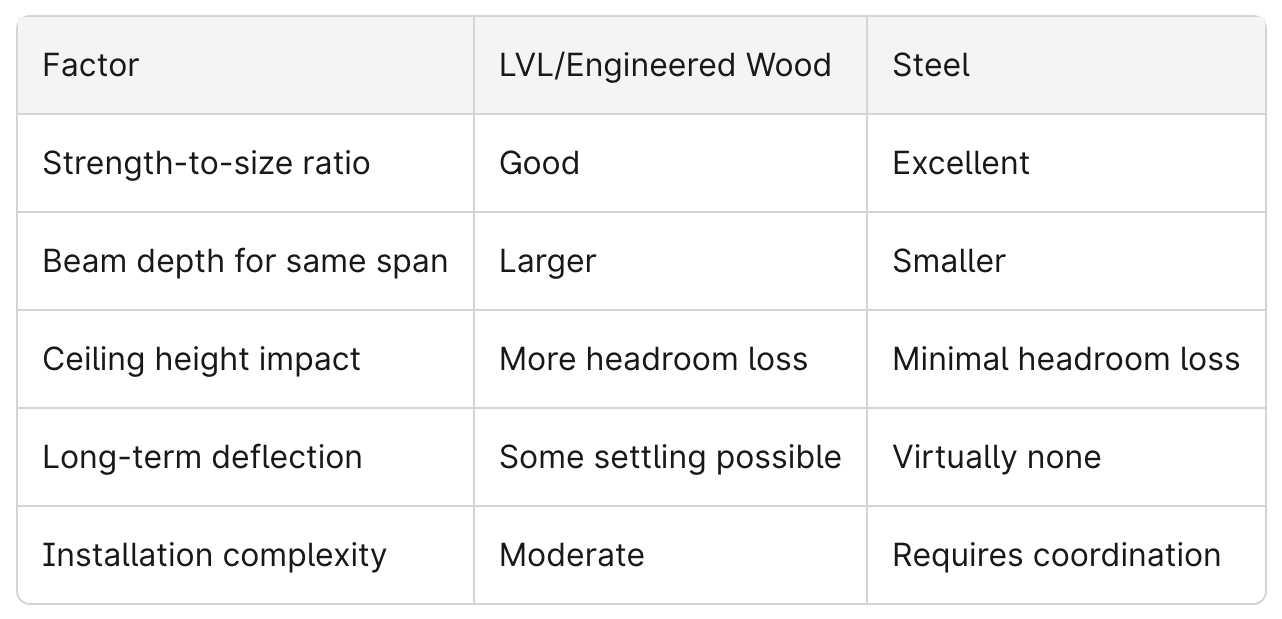
Steel’s superior strength allows for slimmer beams that sit higher in the ceiling plane, preserving headroom in homes where every inch matters. In older Atlanta houses with already-modest ceiling heights, this difference is significant.
Steel beams can be installed several ways:
Recessed into the ceiling framing for a near-flush appearance
Boxed out with drywall as a subtle architectural feature
Left exposed as a design element in industrial or modern renovations
Heide Contracting coordinates steel fabrication, delivery, and installation to minimize disruption. Beams often arrive pre-cut to length, and installation involves careful lifting and positioning rather than extensive on-site cutting.
The beam choice is never about what’s easiest for us. It’s based on calculations that meet building codes and engineering requirements, with consideration for both long-term performance and the aesthetics you want in your finished space.
Protecting Floors, Ceilings, and Historic Character During Wall Removal
Good structural work prevents more than immediate collapse. It prevents the slow, cumulative damage that shows up years later: cracked plaster, sloped floors, doors that stick, crown molding that separates from the ceiling.
When wall bearing loads are mishandled, the effects aren’t always dramatic. Sometimes it’s gradual deflection—a quarter inch per year that adds up over a decade. Sometimes it’s concentrated loads on footings that weren’t designed for them, causing uneven settling. By the time homeowners notice, the damage is expensive to correct.
Techniques We Use to Protect Your Home
Staged jacking: Where floors have already settled, we can sometimes gently re-level them before installing permanent beams
Controlled demolition: We work around historic trim, preserving original elements rather than destroying them
Dust control: Barrier systems and negative air pressure protect adjacent rooms
Sequenced work: We plan the order of operations to minimize exposure of vulnerable finishes
For Atlanta homes with period character, this attention matters. Preserving plaster cove ceilings in a 1930s bungalow while inserting a steel beam requires forethought. Keeping original 1950s brick or wood paneling intact takes planning. Matching existing door casings and baseboards demands sourcing and craftsmanship.
We work to align new beams, soffits, and openings with existing architectural details. The finished space should look like it was always meant to be open—not obviously “cut apart” by someone who didn’t care about the details.
When We Take Over from Other Contractors
This isn’t a comfortable topic, but it’s an important one. Heide Contracting is regularly called in after another contractor starts—or claims to complete—a wall removal without properly addressing wall bearing loads.
Common Issues We Encounter
Walls partially removed with only undersized headers providing support
Missing or inadequate temporary shoring during construction
Beams resting on subfloor instead of proper posts to foundation
No engineering calculations performed
No permits pulled, no inspections completed
Posts bearing on joists that can’t handle the concentrated load
When we arrive to assess these situations, we follow a stabilization-first protocol:
Add emergency shoring if the structure is actively at risk
Document existing conditions thoroughly (photos, measurements, notes)
Assess any damage that has already occurred
Communicate findings clearly to the homeowner
From there, we redesign the solution properly. This means recalculating loads based on actual conditions, specifying correct beam and post sizes, addressing foundation bearing requirements, and rebuilding the opening to meet building codes and structural requirements.
For homeowners, these situations are frustrating and expensive. You paid once for work that wasn’t done correctly, and now you’re paying again to fix it. We understand that frustration.
The lesson isn’t to avoid wall removal. It’s to choose contractors based on their structural expertise, not their low bid. Many general contractors handle wall removal as if it were just another demolition task. They start tearing into framing without understanding where the loads go or how to replace the wall’s function.
If you’re dealing with a situation like this, know that it can usually be corrected. Proper engineering, correctly sized structural members, and code-compliant installation can restore your home’s safety and give you the open floor plan you wanted in the first place.
Wall Bearing and Other Structural Renovations Heide Handles
Load-bearing wall work connects to nearly every major structural renovation we perform across Atlanta. Understanding how vertical loads travel through a building isn’t just academic—it’s the foundation of everything we do.
Related Services That Depend on Wall Bearing Expertise
Table: Related Services That Depend on Wall Bearing Expertise
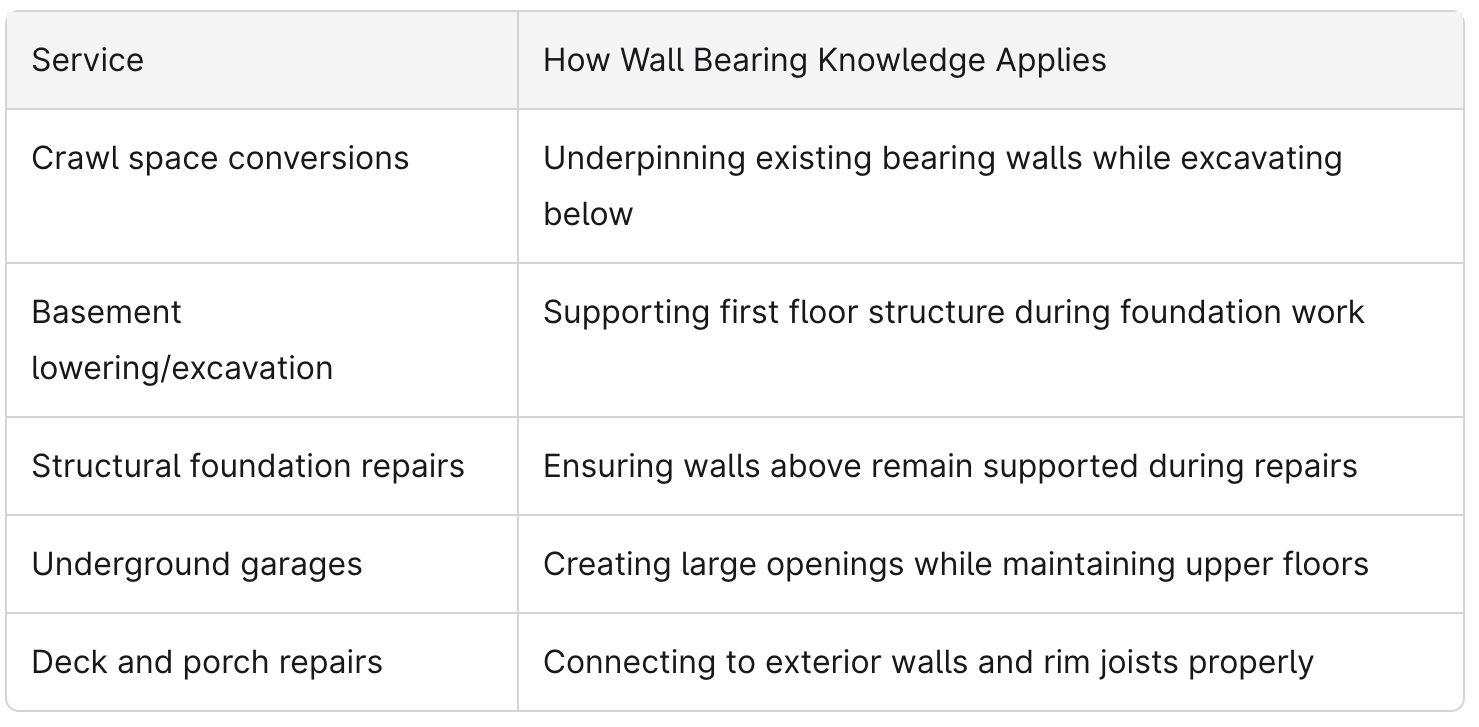
Full-service renovations and additions also require coordinating wall bearing changes with kitchens, bathrooms, and multistory layout updates. You can’t design a dream kitchen with a 12-foot island if you don’t know whether the wall next to it is holding up the second floor.
Lightweight concrete is sometimes used in wall or floor slab renovations to reduce overall weight and make handling easier, especially in multistory or older buildings.
For decks and porches, we repair and rebuild these structures so exterior walls and rim joists remain properly supported. Older Atlanta homes often have porches that have been modified multiple times over the decades, creating complex structural conditions where the outer wall and porch framing have become interdependent.
All of these services share a common goal: letting homeowners expand and modernize their living space without sacrificing the exterior charm or structural integrity of their existing homes.
Costs, Permits, and What Homeowners Can Expect
Wall bearing changes represent significant structural work, and responsible planning includes honest discussion of what’s involved financially and procedurally.
Main Cost Components
Engineering and structural calculations
Permits and required inspections
Demolition and debris removal
Beams and posts (often steel, sometimes engineered wood)
New footings or footing upgrades in crawl space or basement
Drywall, trim, and flooring repairs
Paint and finish work
Actual costs vary substantially based on several factors:
Table: Factors Impacting Cost
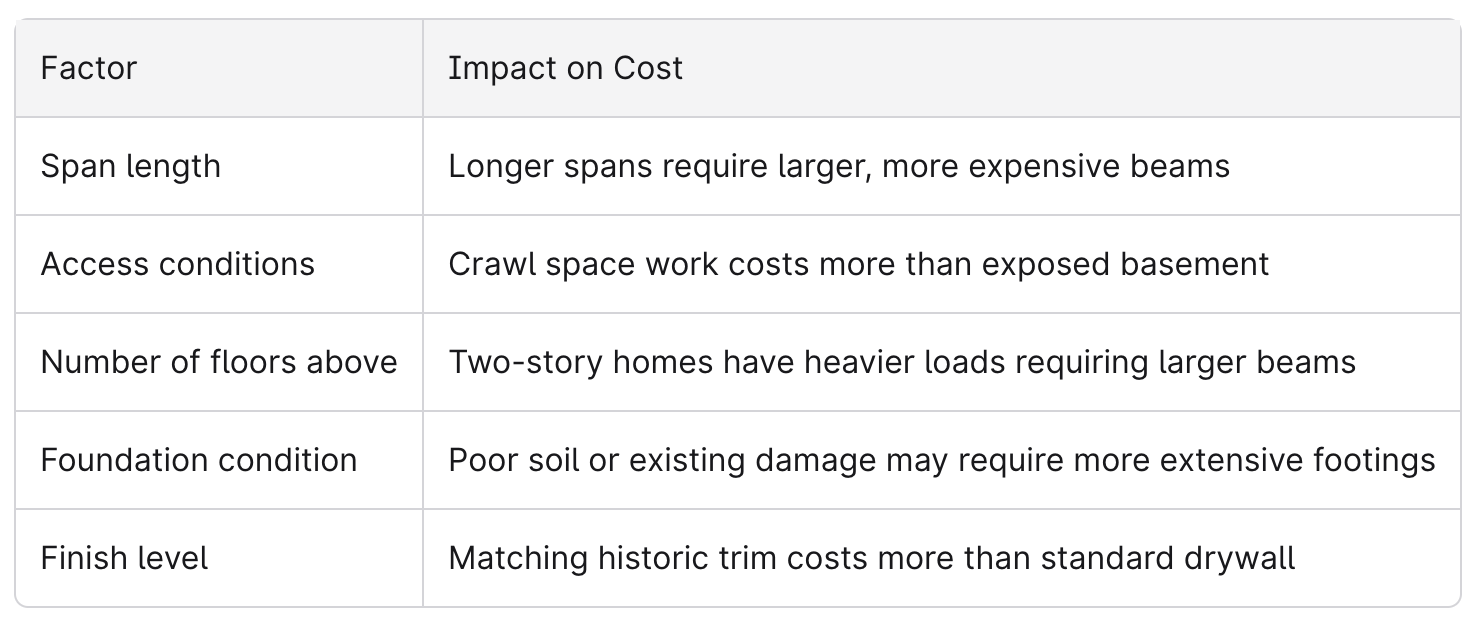
Heide Contracting provides itemized, closed-scope quotes. You’ll see exactly what you’re paying for—no vague allowances, no “plus materials,” no surprise change orders for work that should have been anticipated.
Permitting and Inspections
Atlanta-area jurisdictions require permits for wall bearing modifications. Typical inspections include:
Temporary shoring inspection (before wall removal)
Framing and structural inspection (beam, posts, connections)
Foundation inspection (if new footings are involved)
Final inspection (completed work)
Typical Project Timeline
Initial consultation: Site visit, discussion of goals, preliminary assessment
Engineering and design: 1-2 weeks for calculations and drawings
Permitting: 2-4 weeks depending on jurisdiction
Construction: 3-7 days for typical single-wall removal
Finishing: 1-2 weeks for drywall, paint, and trim
Throughout construction time, we work to minimize disruption to your daily life. Clear communication about schedules, access needs, and what to expect keeps the project running smoothly.
How to Prepare Your Home (and Yourself) for Load-Bearing Wall Removal
Wall bearing work can feel intimidating, especially in a home you love. Good preparation makes the experience more predictable and less stressful.
Practical Steps Before Work Begins
Clear furniture, artwork, and valuables from the work zone and adjacent areas
Cover items you can’t move with plastic sheeting for dust protection
Plan alternate routes through your house if the work area blocks normal traffic patterns
Identify a quiet space away from the work zone for phone calls and focused work
Scheduling Considerations
Consider timing around school schedules, work-from-home demands, or other routine disruptions
Make arrangements for pets who may be stressed by noise and strangers
Alert household members about expected noise levels and hours of work
Plan meals knowing the kitchen may be partially inaccessible
For more tips and trends on timing your renovation projects, visit our blog for insights & innovations in home improvement.
Documentation to Gather
Original blueprints or building plans
Previous engineering reports
Renovation documentation from past projects
Survey or plat showing your lot and home footprint
Design Preparation
Come to the consultation with a wish list for your new open space:
Where do you want kitchen islands, dining areas, or seating?
What sightlines matter most?
How important is preserving existing ceiling height?
What lighting changes are you considering?
When structural and design decisions can be coordinated from day one, the result is a space that works better and costs less to achieve.
Why Choose Heide Contracting for Wall Bearing Changes in Atlanta
Heide Contracting approaches wall bearing work like structural engineers first and remodelers second. Safety and building performance are not negotiable—they’re the foundation of every project we take on.
What Sets Us Apart
Engineering-led planning: Every wall removal starts with proper analysis and calculations
Atlanta expertise: Deep experience with the city’s older and historic home construction
Crawl space and basement proficiency: We understand the foundation conditions common here
Steel capability: Comfortable with long-span solutions that other contractors avoid
Problem-solving track record: We’ve made “impossible” layouts work while preserving period character
When a homeowner wants to combine kitchen, dining, and living rooms without visible posts—and it’s structurally feasible—we find the solution. When an 1890s Victorian needs a modern open-plan addition without destroying its character, we make it work. When another contractor walks away from a complex situation, we see it as an opportunity to demonstrate what careful structural work can accomplish.
Our Commitment to Transparency
Itemized, closed-scope quotes that show every cost component
Clear explanation of structural choices and why we recommend them
Collaborative approach with homeowners, designers, and engineers
Honest assessment of what’s possible, what’s advisable, and what’s risky
We don’t pressure homeowners into decisions. We provide information, answer questions, and help you make choices that serve your home and your family for decades to come.
Ready to explore your options?
Schedule a free consultation and closed-scope quote with Heide Contracting. Bring your questions, your plans, and your wish list. We’ll assess your specific wall bearing situation, explain what’s involved in achieving your open-concept goals, and provide real numbers so you can make an informed decision.
Whether you’re starting fresh or cleaning up someone else’s work, Heide Contracting is Atlanta’s structural renovation expert.
FAQ: Wall Bearing and Load-Bearing Wall Removal
Can I tell for sure if a wall is load bearing just by looking?
Visual clues—perpendicular joists, central location, substantial headers—can suggest a wall might be bearing load, but they’re not definitive. In altered or historic homes especially, previous renovations may have changed the load path in ways that aren’t visible. Professional assessment is essential before any demolition begins. Even experienced contractors get this wrong when they rely on rules of thumb instead of actual analysis.
Is it ever safe to DIY a load-bearing wall removal?
Homeowners can handle planning, design input, and finish work like painting. However, structural design, temporary shoring, and beam installation must be done or directly supervised by qualified professionals. The consequences of miscalculation include structural damage, code violations that affect resale, and genuine safety risks. This is one project where the cost of professional work is justified by the stakes involved.
Will I have to move out while a load-bearing wall is removed?
Most projects can be completed while you remain in the home. Expect noise during construction hours, dust despite our control measures, and temporary closure of rooms in the work zone. Typical wall removal projects take 3-7 days of active construction, with finishing work extending 1-2 weeks beyond that. We can discuss mitigation strategies during your consultation based on your household’s specific needs.
What happens if a previous owner already removed a load-bearing wall incorrectly?
Heide Contracting can assess existing conditions, identify inadequate structural members, and design proper reinforcement. This often means adding new beams, installing posts where they should have been, and upgrading footings if needed. We help document the corrected work for your peace of mind and for future buyers. Fixing someone else’s mistake costs more than doing it right the first time, but it’s almost always possible to restore proper structural support.
How do I know if my contractor is qualified to handle wall bearing work?
Ask about their process for determining if a wall is load bearing. If the answer involves anything less than actual engineering calculations—if it’s based purely on visual inspection or “experience”—proceed with caution. Request to see the structural calculations and beam specifications before work begins. Confirm that permits will be pulled and inspections completed. A qualified contractor welcomes these questions; an unqualified one will minimize their importance.