

Foundation Wall Rebuild in Atlanta Homes
Are you an Atlanta homeowner facing serious foundation wall issues? This comprehensive guide is designed specifically for Atlanta residents who are dealing with significant foundation wall problems—such as bowing, cracking, or failing walls—and are considering a full wall rebuild rather than minor repairs. The scope of this article is focused on complete structural reconstruction, not just cosmetic fixes or patchwork. Understanding the importance of foundation wall stability is crucial: your home’s structural safety, long-term value, and your family’s peace of mind all depend on a sound foundation. In this article, we’ll explain what a foundation wall is, why it matters for your home, and how to approach rebuilding it in Atlanta’s unique conditions.
Key Takeaways
Rebuilding a foundation wall is a full structural reconstruction—not a cosmetic repair—involving temporary house shoring, excavation, demolition of the failed wall, and construction of a new reinforced concrete or masonry wall tied to the existing footing and drainage systems.
Atlanta’s red clay soil expands and contracts dramatically with moisture changes, and combined with heavy rainfall and aging housing stock from the 1920s–1980s, these conditions make foundation wall failures more complex and dangerous than in many other regions.
Ground conditions, such as soil moisture, water flow, and drainage, play a critical role in foundation wall stability. Proper ground-based waterproofing and drainage solutions are essential to prevent damage and maintain structural integrity.
Different foundation structures—such as concrete slabs, basements, and crawl spaces—influence both the repair approach and the types of issues that may arise, including cracks and moisture intrusion.
This is engineering-led work with serious collapse and injury risks if not properly planned and executed; it must be handled by experienced structural contractors who understand load paths, shoring requirements, and local building codes.
Surface-level fixes like crack injections, carbon fiber straps, or anchors often fail within 5–10 years when applied to severely compromised walls, leaving the underlying structural problem unaddressed.
Heide Contracting offers free, closed-scope consultations and itemized quotes for Atlanta homeowners considering a permanent foundation wall solution that protects their home for decades.
What Is a Foundation Wall?
A foundation wall is a critical structural element of your home, designed to support the building and protect it from soil and moisture-related issues. Foundation walls can be made from materials such as poured concrete, concrete masonry units (CMUs), insulated concrete forms (ICFs), wood, and stone. Their main functions include holding back the surrounding soil, creating usable underground spaces like basements or crawl spaces, and preventing soil from collapsing into these areas. A foundation wall also transfers the building's weight to the footings and soil, providing essential support and preventing settling.
Foundation walls are categorized by their functions, including full-height walls for basements, shorter stem walls for crawl spaces, and frost-protected walls for cold climates. The main types of foundation walls include:
Full-height walls for basements: These create deep, usable spaces below the main living area.
Stem walls for elevated structures: Shorter walls that support homes with crawl spaces.
Monolithic slabs: Used in stable soils and warm climates, these combine the floor and foundation in a single pour.
Understanding the type and function of your foundation wall is the first step in determining the right approach to repair or rebuild.
What We Mean by “Rebuilding a Foundation Wall” (Not Just Repair)
This article focuses on full structural reconstruction of a failing foundation wall—the kind of work that goes far beyond crack injections, carbon fiber straps, or surface patching. When we talk about rebuilding, we mean removing a compromised wall entirely and constructing a new reinforced structure in its place. Foundation wall issues are serious, and this guide will help you understand what a foundation wall is, why it matters, and how to rebuild it in Atlanta homes.
Full reconstruction vs. foundation repair: A rebuild addresses walls that are severely bowed, fractured, leaning, or deteriorated to the point where long-term stability is doubtful. This is different from repair methods that target isolated cracks or minor water intrusion.
When a rebuild is considered: Walls with bowing exceeding 2 inches, large horizontal cracks, visible crushing or separation of block or brick, or chronic structural damage that has worsened despite previous repairs.
Permanent solutions over patches: Heide Contracting focuses on lasting solutions rather than temporary cosmetic fixes that leave the underlying failure unaddressed and often lead to expensive repairs down the road.
Whole-house planning required: Rebuilding a foundation wall usually affects adjacent spaces—basement areas, crawl spaces, porches, and decks—and must be planned as a house-wide structural project with careful attention to load paths.
What to expect: A proper wall rebuild involves structural engineering, temporary shoring, controlled excavation, new reinforced construction, and integration with drainage and waterproofing systems.
If you’re seeing wall cracks, uneven floors, or sticking doors that suggest something more serious than cosmetic settling, a rebuild may be the only path to genuine peace of mind and long-term stability.
Why Foundation Walls Fail in Atlanta’s Older Homes
Atlanta’s unique combination of climate, soil conditions, and aging housing stock creates foundation problems that many other regions simply don’t face at the same intensity. Homes built from the 1920s through the 1980s across neighborhoods like Decatur, Virginia-Highland, Kirkwood, and Sandy Springs often sit on foundations designed for an era before modern engineering standards.
Georgia red clay behavior: The Piedmont region’s expansive clay soils (classified as CH under the Unified Soil Classification System) can experience volume changes of 10–15% between wet and dry spells. During heavy rainfall, the clay swells and pushes laterally against walls; during dry spells, it shrinks and withdraws support.
Hydrostatic pressure from heavy rainfall: Atlanta averages 50 inches of rain annually. Repeated storm events—particularly summer thunderstorms and prolonged winter rain—create hydrostatic pressure that pushes against basement and crawl space walls, often exceeding 200–500 pounds per square foot in expansive clay conditions.
Aging materials: Many older Atlanta homes feature unreinforced concrete block, single-wythe brick, undersized footings, and mortar that has weakened over 40–100+ years. These materials were not designed to handle the cumulative stress of decades of soil movement and moisture intrusion.
Past “band-aid” work: Previous homeowners may have installed interior drains without structural upgrades, applied surface crack repairs, or built improper retaining walls that transferred loads into the foundation rather than away from it. This creates hidden structural issues that only become apparent during major failure.
Undocumented modifications: Room additions, enclosed porches, and interior wall removals often happened without engineering review. These changes can alter load paths in ways that stress original foundation walls beyond their design capacity.
Common homeowner warning signs: Walls bowing inward, horizontal cracks in block, stair-step cracks in brick veneer, chronic moisture buildup, musty smell in basements, sagging floors above, and water intrusion after rain are all indicators that something more than cosmetic repair may be needed.
When these conditions combine—as they frequently do in older Atlanta homes—the result is often a foundation wall that cannot be stabilized with anchors or straps alone. Soil erosion, moisture control failures, and decades of alternating pressure have compromised the wall’s structural integrity beyond what surface-level intervention can restore.
Rebuilding a Foundation Wall: Step-by-Step Process
Rebuilding a foundation wall is a carefully sequenced process designed to keep your home safely supported at every stage. Each phase builds on the previous one, with no shortcuts that could compromise safety or structural performance.
1. Engineering and Planning
Before any physical work begins, a structural engineer assesses the wall, calculates loads, and develops a stamped plan specific to your home. This includes obtaining permits from the City of Atlanta or local county offices (Fulton, DeKalb, Cobb) as required. This planning phase ensures the new wall will handle actual loads—not just estimated ones.
2. Temporary Shoring
Steel beams, adjustable posts (acrow props), and cribbing systems are installed to carry the home’s loads while the existing wall is removed. Shoring is typically spaced 4–6 feet on center and engineered to 1.5–2.0 times safety factors under standard load combinations. This is where expertise matters most—improper shoring is the leading cause of structural failure during wall work.
3. Exterior Excavation
Soil is carefully removed along the failing wall in sequenced lifts of 2–3 feet to minimize surcharge pressure. This exterior excavation protects nearby utilities, landscaping, and neighboring property while managing groundwater that may flow into the work area. OSHA-compliant shoring or sheeting prevents trench cave-ins.
4. Demolition of the Failed Wall
The compromised wall—whether concrete block, brick, or poured concrete—is removed in controlled sections. Crews take care to protect adjacent walls, floor framing, support beams, and any mechanical systems that may run near the work area.
5. Construction of the New Wall
A new reinforced wall is constructed using poured concrete (typically 4,000 psi minimum) or reinforced concrete masonry units (CMU). Vertical and horizontal rebar cages are tied into the existing footing using L-shaped dowels at proper spacing. The new wall is designed to handle both vertical loads from the house above and lateral pressure from the soil.
6. Integration with Structure and Drainage
The new wall is tied into floor framing, sill plates, and load paths using epoxy-anchored bolts. Drainage systems—including French drains, footing drains, and sump pumps where needed—are integrated before backfilling. Waterproofing membranes or drain boards are applied to the exterior face.
7. Backfill and Restoration
Compacted backfill (often with drainage stone near the wall) is placed in lifts, followed by final grading adjustments. Walkways, porches, landscaping, and any disturbed exterior elements are restored to complete the project.
This process typically spans several weeks for planning and permits, with on-site work ranging from several days to a few weeks depending on wall length, access, and complexity.
How Heide Contracting Designs a Safe, Permanent Wall Rebuild
Heide Contracting treats every wall rebuild as a structural engineering project, not a generic foundation repair company approach. Each Atlanta home presents unique conditions that demand custom solutions.
Engineering-led planning: We collaborate with licensed structural engineers to produce stamped plans, reinforcement schedules, and construction sequencing specific to your home. This isn’t template work—it’s analysis based on your actual loads, soil conditions, and existing foundation.
Advanced shoring systems: Our skilled team designs custom steel shoring frames, temporary beams, and adjustable posts matched to your house’s actual load paths and rooflines. We don’t rely on generic approaches that may work for some homes but fail for others.
Reinforcement strategy: Vertical and horizontal rebar, bond beams, proper lap splices, and connections into existing footings create continuous strength. We use advanced techniques that integrate the new wall with adjacent structural elements so load paths remain uninterrupted.
Drainage and moisture management: Exterior footing drains, French drains, drainage boards, and waterproofing membranes are tailored to Atlanta’s heavy rainfall and red clay conditions. The goal is basement waterproofing that prevents moisture buildup and keeps your basement dry for decades.
Coordination with broader projects: Many clients combine wall rebuilds with crawl space conversion, basement lowering, underground garages, or load-bearing wall removals. We design the new foundation to support these future or concurrent renovations.
Documentation and transparency: You receive itemized, closed-scope quotes with clear drawings and timelines. No hidden costs, no vague descriptions—you understand exactly what is being rebuilt and why.
Why Wall Rebuilds Are High-Risk Work That Demand Professionals
Removing a foundation wall while a house remains in place is inherently dangerous work that requires proper engineering and experienced execution. For those considering such a project, it's crucial to work with professionals who specialize in expert load-bearing wall removal services. This isn’t an area where do it yourself approaches or inexperienced contractors should attempt to save costs.
Collapse risk: If shoring is undersized, poorly placed, or incorrectly sequenced, loads can shift suddenly. This can cause structural failure, serious injury, and damage to neighboring property. Historical data from FEMA reports indicate 2–3 collapse incidents annually in Georgia related to under-engineered excavation work.
Hidden conditions in older homes: Unknown additions, cut joists, unconventional framing, and prior work that was never documented complicate accurate load tracking. What appears straightforward from outside may reveal serious foundation issues once demolition begins.
Soil and water risks: Red clay can slough unexpectedly into work areas. Groundwater may flow suddenly during excavation, especially after heavy rainfall. Trench cave-ins remain a serious hazard without proper shoring systems.
Code, permit, and inspection requirements: Local building departments require engineering and staged inspections for removal and replacement of load-bearing foundation elements. Skipping this process creates liability and may void insurance coverage.
Common shortcuts to avoid: Leaving a severely bowed wall in place and adding anchors (which fail at 60–70% rates within 5 years in expansive soils), shoring with inadequate lumber, or excavating too deep without trench safety are all approaches that create more risk than they solve.
Heide Contracting crews are trained specifically for structural reconstruction work, with appropriate safety protocols, insurance, and experience in Atlanta’s challenging conditions. Our service area spans the Atlanta metro area, and we specialize in exactly this type of high-risk foundation work.
Foundation Wall Rebuild Options: Concrete vs. Reinforced Masonry
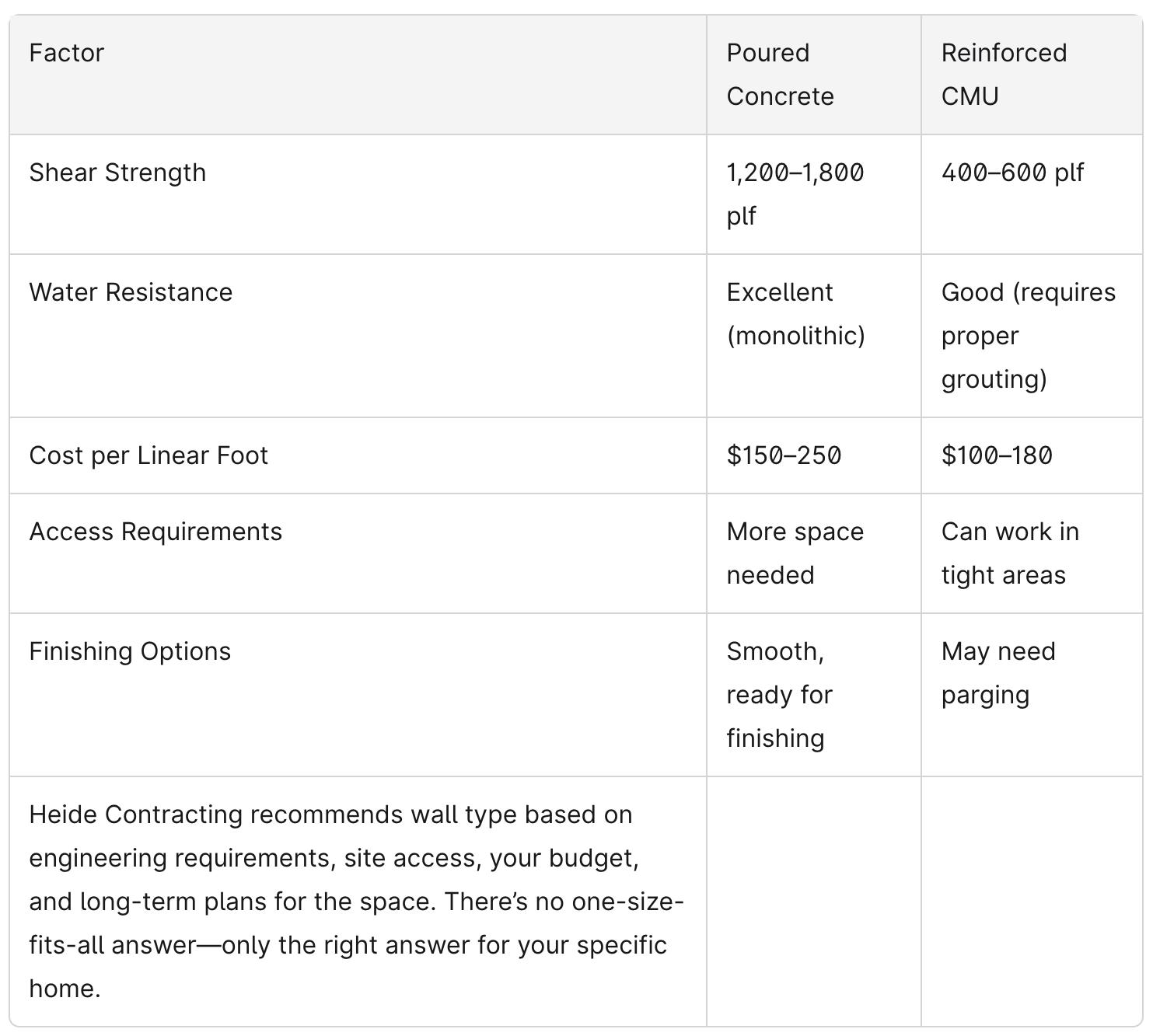
When reconstructing a foundation wall, two primary structural options exist: cast-in-place concrete walls and reinforced concrete masonry unit (CMU) block walls. Both can deliver excellent long-term performance when properly engineered and constructed.
Poured-in-Place Concrete
Poured concrete walls are monolithic structures formed on-site and filled with concrete typically rated at 4,000 psi or higher. This approach is often recommended for:
High lateral loads from deep basements or severe soil pressure
Sites where access allows formwork and concrete pumping equipment
Situations requiring maximum shear strength (1,200–1,800 pounds per linear foot)
Homes where the wall will be visible and a smooth finish is desired
Poured walls form a continuous barrier against water intrusion when combined with proper waterproofing, making them excellent for leaky basements renovations.
Reinforced CMU Block
Reinforced masonry uses concrete blocks filled with grout and reinforced with vertical and horizontal rebar. This approach works well for:
Basements and crawl spaces where working space is limited
Sites with access constraints that make concrete trucks difficult
Projects where modular construction allows better control and inspection
Budget-conscious projects where material costs are a factor
CMU walls achieve shear strength of 400–600 pounds per linear foot, which is adequate for many residential applications when properly reinforced.
Performance Comparison
Integrating Drainage, Waterproofing, and Moisture Control
A rebuilt foundation wall is an opportunity to permanently address drainage issues and prevent moisture problems that may have contributed to the original wall failure.
Exterior French Drains and Footing Drains
Exterior French drains and footing drains: Installed along the new wall with proper gravel, filter fabric, and discharge routing away from the house. These systems can manage water inflows up to 10 gallons per minute per 100 feet of wall.
Waterproofing Membranes and Coatings
Waterproofing membranes and coatings: Modern 60-mil HDPE membranes, dimple boards, or drainage mats are applied to the exterior face before backfilling. This creates a physical barrier that directs water to the drainage system. Moisture control is essential for foundation walls to prevent water intrusion and protect non-resistant materials from ground contact.
Grading Improvements
Grading improvements: Reshaping soil to slope away from the home, adding swales, and relocating downspouts ensures surface water runs away from your home’s foundation rather than pooling against it.
Interior Moisture Strategies
Interior moisture strategies: Vapor barriers in crawl spaces, sump pits with sump pumps, and dehumidification systems work alongside exterior drainage to create comprehensive moisture control.
Mold Prevention
Mold prevention: Proper drainage and moisture management prevent the conditions that lead to mold growth and the associated musty smell in basements and crawl spaces.
Heide Contracting focuses on structural integrity first but coordinates closely with drainage and moisture systems to protect the new wall over decades. Water damage is the most common cause of foundation deterioration, so we address it systematically.
Minimizing Disruption While Protecting the Rest of Your Home
Although rebuilding a foundation wall is major work, Heide Contracting plans projects to keep families as comfortable and safe as possible throughout construction.
Site protection measures: Dust control barriers, floor and stair coverings, and careful routing of equipment through the property minimize impact on living spaces. We treat your house with respect.
Clear scheduling and communication: You receive clear start dates, daily progress updates, and predictable phases so you can plan around noise and access limitations. No surprises.
Utilities coordination: HVAC, plumbing, and electrical lines that cross or rest on the wall being rebuilt receive temporary support. We work to maintain function wherever possible during construction.
Preserving exterior character: Brick, siding, porches, landscaping, and historic details are protected during work and restored after structural construction is complete. This matters especially in Atlanta’s older neighborhoods.
Working in tight spaces: Our team has extensive experience on constrained urban lots in intown Atlanta where access is limited and neighbors are close. We know how to execute major structural work without creating problems for surrounding property.
Living through a wall rebuild is manageable when the project is planned with your daily life in mind.
How a Foundation Wall Rebuild Fits into Larger Renovation Goals
Many Atlanta homeowners consider foundation wall reconstruction alongside bigger home transformations rather than as an isolated repair expense. When you’re already opening up the foundation, it makes sense to think about what else you might accomplish.
Crawl space conversion: Turning a damp, unusable crawl space into a finished basement or storage area often makes sense when the perimeter walls are being rebuilt anyway.
Basement lowering and excavation: Gaining headroom in an older basement frequently requires addressing the foundation walls as part of the project.
Underground garage: In hilly Atlanta neighborhoods, below-grade parking is increasingly popular and requires properly engineered foundation walls.
Future load-bearing wall removal: A new foundation wall can be engineered to support future kitchen expansions, open floor plans, or multi-story additions above.
Full-service renovation: Heide Contracting handles structural foundation work alongside interior remodeling and historic character preservation, so you have one company coordinating the entire project.
Example scenario: A 1960s Decatur home with a failing block wall in the crawl space could combine a crawl space repair and conversion—creating a new family room or workshop with a structurally sound perimeter, proper waterproofing, and integrated HVAC from a single coordinated project.
A foundation wall rebuild isn’t just a repair expense—it’s literally and figuratively the foundation for long-term home improvement.
Cost, Timeline, and What to Expect From a Quote
Full wall rebuilds are more involved and more costly than typical foundation repair services, reflecting the structural scope, safety requirements, and engineering expertise involved. However, they also deliver lasting solutions that prevent repeated spending on fixes that don’t hold.
Cost Factors
Costs in Atlanta can range from $30,000 to $100,000 or more depending on:
Wall length and height
Site access and excavation complexity
Soil conditions and groundwater management needs
Whether other structural upgrades (basement lowering, crawl space conversion) are combined with the project
Permitting and engineering requirements
Timeline Expectations
Planning and permits: Several weeks for engineering, drawings, and permit approval
On-site work: Several days to a few weeks depending on complexity
Total project duration: 4–8 weeks is common for a full wall rebuild
What Heide Contracting’s Free Consultation Includes
On-site assessment with photo documentation
Preliminary measurements and visual inspection
Clear explanation of structural findings
Discussion of whether monitoring, reinforcement, or full rebuild is appropriate
No pressure—just information
Itemized, Closed-Scope Quotes
You receive a free quote that shows exactly what is included: engineering, shoring, demolition, new wall construction, drainage integration, and restoration. No vague line items, no surprise charges, no financing options pressure.
We prioritize durable, code-compliant solutions over low initial price. This approach helps homeowners avoid the cycle of common foundation problems followed by repeated expensive repairs that add up to more than doing it right the first time.
Financing Options for Foundation Wall Rebuilds
Foundation wall rebuilds represent a major investment in your home’s safety and value, but the cost can be daunting for many Atlanta homeowners. At Heide Contracting, we understand that foundation repair services, basement waterproofing, and crawl space repair are essential to maintaining your home’s structural integrity—yet they often come at a time when you least expect it. That’s why we offer a range of financing options designed to make these critical repairs more affordable and accessible throughout the Atlanta metro area.
Our financing solutions include flexible loans and payment plans tailored to your budget, so you don’t have to delay addressing foundation problems like wall cracks, uneven floors, sagging floors, or moisture buildup. By making it easier to invest in trusted foundation repair now, you can avoid the risk of more expensive repairs down the road—such as those caused by soil erosion, water damage, or mold growth. Early intervention not only protects your home’s foundation but also preserves your peace of mind and property value.
Heide Contracting’s skilled team specializes in advanced techniques for foundation repair, including the installation of helical piers, support beams, and comprehensive moisture control systems. Whether you’re dealing with foundation damage in an older home, leaky basements, or planning new construction, our experts provide lasting solutions that address both immediate and long-term needs. We also integrate waterproofing and drainage improvements to keep your basement dry and prevent common foundation problems from recurring.
As a trusted foundation repair company serving the Atlanta area, we are committed to transparency and customer satisfaction. Our service area covers the entire Atlanta metro region, and we offer free estimates and itemized quotes for all foundation wall rebuilds and related services. With our financing options, you can move forward with repairs confidently, knowing you’re working with a company that prioritizes your safety, comfort, and financial well-being.
Don’t let foundation issues go unaddressed or put off necessary repairs due to cost concerns. Contact Heide Contracting today to learn more about our affordable financing options, schedule a free consultation, and take the first step toward a secure, stable, and healthy home. Our team is here to help you find the best solution for your foundation repair needs—so you can enjoy lasting peace of mind for years to come.
When to Consider a Full Wall Rebuild Instead of a Repair
Not every crack or leak means a wall must be rebuilt. But certain conditions do justify full reconstruction rather than attempting to patch a fundamentally compromised structure.
Structural Indicators That Suggest a Rebuild
Severe bowing (more than 1–2 inches inward)
Large horizontal cracks in block walls
Walls visibly out of plumb (leaning)
Sections where block or brick has crushed, shifted, or separated
Multiple structural issues in the same wall
Chronic Damage Patterns
Repeated flooding or water damage despite previous waterproofing attempts
Advanced mortar deterioration
Widespread spalling that has reduced the wall’s effective thickness
Evidence of movement that has progressed over years even when left unaddressed
Cumulative Modifications
Added stories or heavy additions that increased loads
Interior wall removals that changed load paths
Enclosed porches or additions built without foundation upgrades
Heide Contracting will explain whether repair, reinforcement, or full reconstruction is the safest and most cost-effective long-term option for your specific situation. We don’t push toward the most expensive solution—we recommend what will actually protect your home.
Why Atlanta Homeowners Choose Heide Contracting for Structural Foundation Work
Heide Contracting specializes in structural projects that many general contractors and even other foundation repair company operations prefer to avoid. Full foundation wall rebuilds require expertise, equipment, and experience that most firms simply don’t have.
Local expertise in Georgia conditions: Deep experience with Atlanta’s red clay, older homes from new construction through century-old structures, and mixed foundation types across neighborhoods from Sandy Springs to Decatur to Marietta.
Integrated structural services: We handle crawl space conversion, basement lowering, load-bearing wall removal, deck and porch repairs, and full-home renovations—coordinating foundation work with everything above it.
Homeowner advocacy: Clear communication, honest assessment of risk, and refusal to apply quick cosmetic fixes where structural reconstruction is the responsible choice. We’d rather tell you the truth than sell you something that won’t last.
Engineering-driven approach: Every project starts with proper structural analysis. Work is permit-compliant and built around protecting both the house and the people living in it.
Trusted foundation repair reputation: Our company has built a reputation in the Atlanta area as the team homeowners call when other contractors won’t take on complex structural work.
When foundation problems require real solutions—not just affordable patches—Atlanta homeowners consistently choose Heide Contracting.
Next Steps: Schedule a Safe, Clear Evaluation of Your Foundation Wall
If you’re seeing significant wall movement, cracking, moisture intrusion, or signs of structural issues in your Atlanta home, the first step is a professional structural evaluation. Understanding what you’re dealing with allows you to make informed decisions about how to address it.
Free consultation: Heide Contracting offers a free estimate that includes on-site inspection, review of symptoms, and honest assessment of whether monitoring, reinforcement, or full rebuild is appropriate.
Itemized, closed-scope quote: If work is recommended, you receive a detailed quote outlining the solution, expected timeline, and exactly how the project will protect the rest of your home.
Bring documentation: Past foundation reports, renovation plans, or photos of changes over time help us understand your home’s history and provide the most accurate assessment.
No pressure: Our goal is to give you clarity, not to create urgency. Many walls can be monitored. Some need reinforcement. Others genuinely require rebuilding.
Addressing significant wall issues now—properly and permanently—protects your safety, your property value, and your future renovation plans. Contact Heide Contracting for a free quote and discover what it takes to give your home’s foundation the strength it needs for the next 75 years.
FAQ: Rebuilding a Foundation Wall in Atlanta
Do I have to move out while my foundation wall is being rebuilt?
Many projects allow homeowners to stay in their homes throughout construction. However, access to certain rooms may be limited during active work phases, and there will be noise during demolition and construction. Safety zones are established around the work area. Heide Contracting advises each client based on the specific project scope—smaller wall sections may cause minimal disruption, while full basement perimeter work might make temporary relocation more comfortable for some families.
Can I finish my basement after a foundation wall rebuild?
A new reinforced foundation wall is an excellent starting point for a finished basement. The wall is structurally sound, properly waterproofed, and ready for framing, insulation, and drywall. Heide Contracting can coordinate finishing work as a later phase or include it as part of the same project if you’re ready to transform the space immediately after the structural work is complete.
Will insurance help pay for a foundation wall rebuild?
Most homeowner’s insurance policies exclude long-term settlement, soil movement, and gradual deterioration from coverage. However, certain sudden events—like damage from a burst pipe or documented storm damage—may be covered depending on your policy. We recommend speaking with your insurer early in the process. Heide Contracting provides detailed documentation of conditions and work performed that can support insurance claims where coverage applies.
How long will a rebuilt foundation wall last?
Properly engineered and constructed reinforced walls, with good drainage and waterproofing, are designed to perform for the life of the structure under normal conditions—typically 75 years or more. The key factors are quality of materials, proper reinforcement, adequate drainage, and protection from the moisture and soil conditions that caused the original wall to fail.
What if only one section of my wall is failing?
Partial rebuilds are sometimes appropriate and cost-effective. Heide Contracting evaluates whether reconstructing just the failed section provides adequate structural continuity or whether extending work along more of the wall is wiser for long-term strength. Factors include how the failed section connects to adjacent walls, whether the existing portions show early signs of similar problems, and the overall load distribution in your specific home. We’ll explain the trade-offs clearly so you can make an informed decision.