

Stop-Gap Fixes vs. Real Sagging Floor Joist Repair
If you’re searching for how to fix sagging floor joists, you’ve probably noticed something isn’t right underfoot. Maybe there’s a soft spot near the kitchen, a noticeable dip in the hallway, or that unsettling bounce when you walk across your living room. For Atlanta homeowners—especially those in older homes built before modern building codes—this isn’t just an annoyance. It’s your house telling you something structural has shifted.
Here’s what most contractors won’t say directly: sagging floor joist repair in crawl spaces and basements is one interconnected structural issue, not a cosmetic patch or simple “leveling” job. The floor system under your feet is a network of joists, beams, columns, and footings all working together. When one component fails, the stress transfers to others. Shimming a subfloor or adding a random jack post treats a symptom while ignoring the underlying condition.
The typical industry approach involves sistering a few joists, propping up a beam with hardware-store screw jacks, or laying plywood patches over soft spots. Sistering joists involves attaching a new, identical joist alongside an existing sagging joist using bolts, nails, or screws. These methods can buy time, but they rarely address why the floor sagged in the first place. When jacking and temporary supports are used, incremental jacking with adjustable steel jacks must be performed slowly to avoid structural damage. Heide Contracting approaches sagging floors differently—through engineering-led structural repairs that diagnose root causes, specify appropriate materials, and execute fixes designed to last decades.
We fix joists from below, working in crawl spaces and basements where the real structural work happens. Our team specializes in structural repairs for crawlspaces and basements, ensuring long-term stability. Our solutions are designed to work with future renovations, home additions, and load-bearing wall changes—not just to get you through the next few years. Our service philosophy is built on quality workmanship, clear communication, and a commitment to customer satisfaction. And unlike remote advice or generic repair kits, we provide in-person evaluations throughout Atlanta and nearby suburbs, because every home’s structure has its own story.
Why Atlanta Floors Sag: Real Causes in Older & Historic Homes
Understanding why your floors are sagging is the first step toward fixing them correctly. Atlanta’s housing stock—from Craftsman bungalows to mid-century ranches—carries decades of history in its framing, and that history often includes several factors working against structural stability.
Common causes of sagging floors in Atlanta homes include:
Undersized or over-spanned floor joists: Many Atlanta homes built between the 1920s and 1980s have joists that met the standards of their era but fall short of today’s expectations. Bungalows, post-war cottages, and 1960s ranches often feature 2x8 joists spanning distances that would now require 2x10s or 2x12s. The framing was adequate for original loads, but not for modern living patterns.
Chronic moisture exposure from Georgia’s climate: Georgia red clay doesn’t drain well. High humidity, seasonal heavy rainfall, and wet crawl spaces create conditions where wood rot and mold growth attack joists, beams, and sill plates over time. Moisture doesn’t just weaken wood—it invites termites and carpenter ants that compound the damage.
Layout changes that altered load distribution: Open floor plans became popular in the 1990s and 2000s, leading many homeowners to remove walls without understanding which ones were load-bearing. Heavy kitchen islands, stone counters, soaking tubs, and large appliances were added directly over older framing never designed for these concentrated loads.
DIY alterations and prior contractor shortcuts: Over decades, well-meaning homeowners and rushed contractors have cut notches too deep, drilled oversized holes for plumbing, or removed blocking and bridging that tied the joist network together. Each modification weakened the system incrementally.
Plumbing leaks and HVAC condensation: Throughout metro Atlanta neighborhoods—Decatur, East Point, Marietta, Roswell—plumbing failures and poorly insulated ductwork have soaked framing members for years before anyone noticed. By the time a floor sags, the wood may have been deteriorating for a decade.
Failed or inadequate original supports: Interior beams resting on undersized footings, columns bearing on unstable soil, or sill plates sitting on deteriorating foundation walls can all allow floors to settle unevenly.
The key point is this: floors sag because the entire support system—joists, beams, columns, footings, and ground below—is out of balance. It’s rarely about “one bad board.” Addressing only the most visible symptom guarantees the problem will return or spread elsewhere.
Signs Your Floor Joists Need Structural Repair – Not Just a Shim
How do you know if your sagging floors require genuine structural repair versus a minor adjustment? The symptoms below indicate something more serious is happening beneath your feet.
Floor-level warning signs:
Soft or bouncy spots in hallways, near kitchens, or at the center of rooms
Noticeable dips or slopes, especially in front of fireplaces, under bathtubs, or near exterior walls
Furniture that leans toward one corner or rocks on surfaces that appear flat
Cracked tile along cabinet runs or in bathroom floors
Gaps opening between baseboards and flooring, particularly where walls meet floors
Whole-house indicators:
Doors that rub at the top or bottom, or swing open or closed on their own
Interior partition walls showing diagonal cracks at corners
Gaps appearing at crown molding or where walls meet ceilings
Sticking doors and windows that operated smoothly when the home was newer
Below-floor warning signs:
Musty odors rising from the first floor, especially in humid weather
Visible fungus, staining, or dark discoloration on floor framing in the crawl space or basement
Rusted or tilting “temporary” jack posts that have been in place for years
Sagging beams or joists visible when you look up from below
Prior repairs that appear makeshift—scrap lumber nailed haphazardly, shims stacked precariously
These symptoms rarely stay isolated. Left alone, structural damage tends to spread across rooms, making future renovations more complex and expensive. What starts as a soft spot in the kitchen can eventually affect plaster walls in the living room, create uneven floors in bedrooms, and undermine the stability of any additions or remodeling projects you might consider.
How Heide Contracting Diagnoses Sagging Joists in Crawl Spaces & Basements
We start as structural problem-solvers, not product salespeople. Before recommending any repair, we need to understand exactly what’s happening beneath your floors and why. Our engineering-led service process examines the whole framing system, not just the most obvious symptom, ensuring quality workmanship and customer satisfaction throughout every step.
Our on-site structural assessment includes:
Physical inspection from below: We enter the crawl space or basement and systematically map joist spans, beam runs, column locations, and how they relate to walls and heavy loads above. This reveals whether the original framing was adequate and where it has failed.
Condition evaluation: We look for undersized joists, over-spans, rot, insect damage, rusted hardware, cracked or split lumber, and evidence of failed prior repairs. We examine bearing conditions at foundation walls and interior supports.
Moisture documentation: We record moisture levels using appropriate meters, inspect for past flooding, check for condensation from HVAC systems, and identify drainage or ventilation problems that must be corrected before structural repairs can succeed.
Load path analysis: For complex cases or larger renovations, we bring in or coordinate with a structural engineer to model loads, calculate deflection limits, and predict long-term movement. This ensures repairs meet or exceed current industry standards.
Professional foundation repair services often include free inspections to assess the condition of the foundation, helping homeowners make informed decisions about necessary repairs.
Every homeowner receives a clear, closed-scope, itemized quote. You’ll know exactly which joists or beams we will reinforce, what steel or lumber we will use, and how access and restoration will be handled. No vague estimates, no surprise add-ons, no guesswork.
Our service area covers the entire Atlanta metro region and surrounding neighborhoods—contact us to confirm if your home is within our service area.
Crawl Space Joist Repair: Stabilizing Floors from Below
Crawl space joist repair is foundational work that improves safety, comfort, and renovation potential for Atlanta homes with shallow foundations. Done correctly, it transforms a deteriorating floor system into a stable platform for the next 40+ years of use.
Creating stable bearing:
We address the support structure first, because reinforcing joists that rest on failing beams accomplishes nothing. This may involve adding or replacing support beams (girders), installing properly sized concrete footings, and using engineered steel posts instead of the adjustable screw jacks sold at hardware stores. Those consumer-grade jacks are designed for temporary use—not permanent structural support. Crawl space support posts, such as IntelliJacks, can prevent sagging floors by providing upward support to floor joists and are a proven solution for long-term stability in the crawlspace.
Selective joist repair:
Sistering with full-length lumber or LVL (laminated veneer lumber) where the original joist is weakened but salvageable. We follow proper attachment patterns—structural adhesive combined with systematic fastening—so the old and new members work as a unified beam.
Partial sistering when physical constraints prevent full-length installation. The reinforcement extends at least three feet beyond the damaged area on each side.
Complete joist replacement when rot or damage is too extensive for sistering to be effective.
Steel-enabled solutions for challenging spans:
In tight crawl spaces where wood alone cannot safely carry longer spans or heavy modern loads, we install steel beams or steel-reinforced dropped girders. Steel provides the strength needed without requiring multiple closely-spaced posts that would clutter the space.
Controlled re-leveling:
Sagging floors must be lifted gradually. Aggressive jacking can pop subfloors loose, crack plaster walls, break tile, and damage original hardwood. We use jacking sequences that apply pressure incrementally over days or weeks, protecting finishes above while restoring level below.
Addressing moisture and soil support is crucial for property stability; for expert help, consider foundation repair services in Atlanta from Heide Contracting.
Joist repairs in a wet crawlspace or basement will simply rot again. We coordinate moisture control measures—improved drainage, vapor barriers, encapsulation, dehumidification, and comprehensive waterproofing solutions—to keep the crawlspace and basement dry and prevent moisture intrusion that can exacerbate foundation issues. Waterproofing is essential for protecting both basements and crawl spaces from water damage, mold growth, and structural problems. For support columns, we ensure footings bear on stable ground, not on loose fill or deteriorated soil.
Throughout this process, we keep disruption minimal. We protect landscaping where we dig footings, maintain clean access paths, and leave the crawlspace orderly when we’re finished.
Basement Joist & Beam Repair: Working Around Existing Living Space
Basements in Atlanta—especially in older intown neighborhoods and 1960s through 1980s suburbs—often carry major loads from multiple stories above. Kitchen loads, bathroom loads, and the weight of interior partition walls all transfer through basement-level framing. Joist and beam repair here must be engineered carefully, particularly when the basement is already finished as living space. When installing steel I-beams, we anchor them directly to the basement floor to provide support and stabilize the walls against inward movement.
Inspection approach:
For finished basements, we remove small access panels or ceiling sections as needed to examine the structure above. We document beam deflection, column alignment, and any cracking at supports. Unfinished basements allow more comprehensive visual inspection, but we still systematically map the load paths to understand how forces move through the framing. If we observe signs of water intrusion, such as leaky basements or structural cracks in the walls, we recommend basement waterproofing solutions to prevent further damage and maintain structural integrity.
Strengthening options:
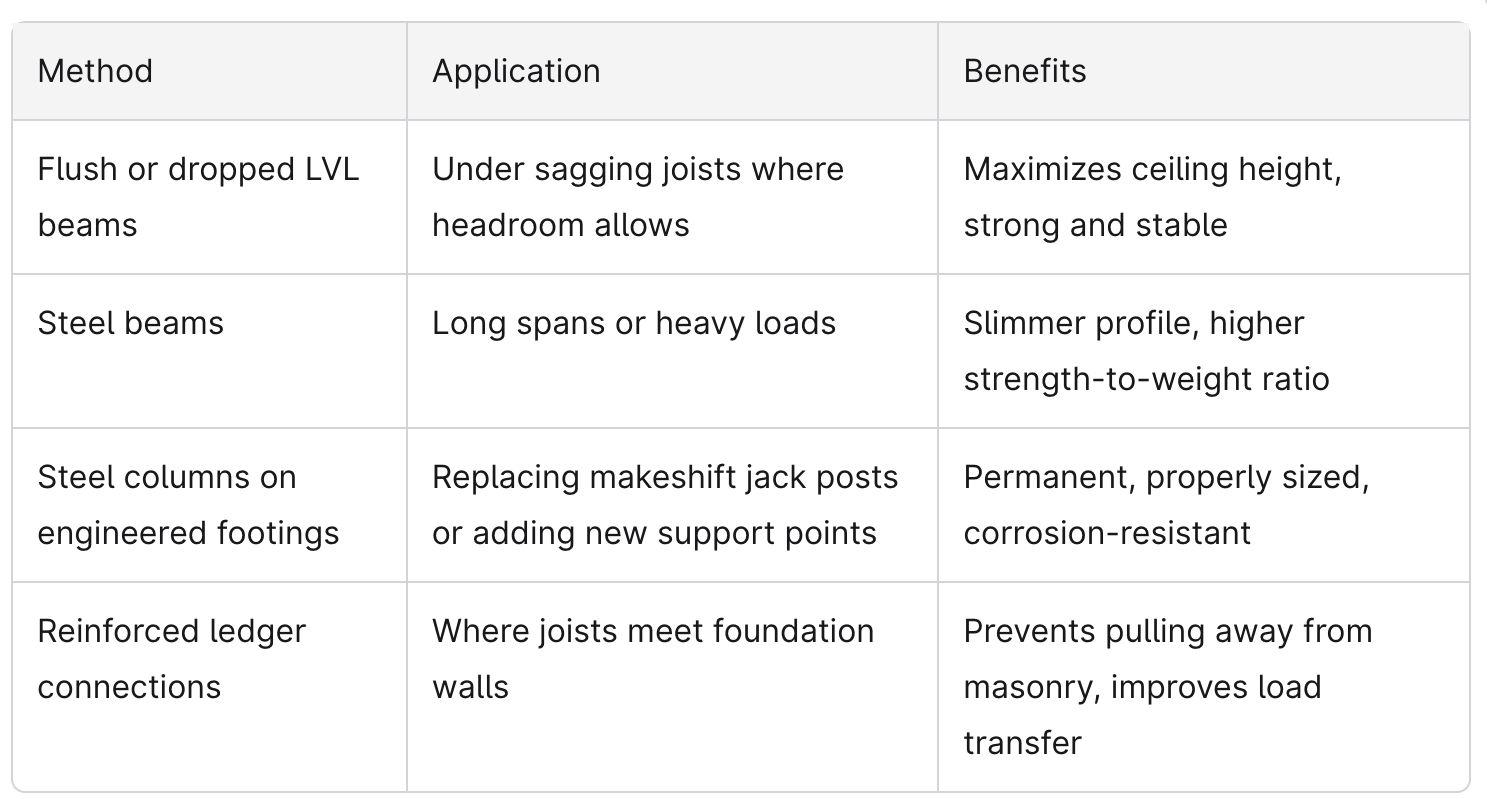
For homes experiencing foundation settlement or shifting, we may recommend foundation piers to stabilize and support the structure. Push piers are hydraulically driven into the ground until they reach stable soil, making them ideal for larger structures. Helical piers, which are steel rods with helical plates, are screwed into the soil using hydraulic equipment. Helical pier installation is effective for reaching stable soil or bedrock (the load bearing strata), and these piers are especially suitable for lighter structures or perimeter foundation support due to their quick installation process. The choice between push piers and helical piers depends on soil conditions and the specific needs of your home. Exterior excavation is often recommended alongside drainage solutions to reduce hydrostatic pressure and ensure a more durable basement wall repair.
Preserving finished spaces:
When basements are already finished with drywall, flooring, or mechanical systems, we design repair plans that preserve ceiling height wherever possible, route new supports around utilities, and limit demolition to what’s genuinely necessary. We communicate clearly about which finishes will be opened and how they’ll be restored.
Compatibility with future remodeling:
We often coordinate joist and beam upgrades with basement finishing projects, home additions, or removal of load-bearing walls upstairs. By engineering the structure for anticipated future loads, we ensure you won’t need to tear into the basement ceiling again when you decide to open up your kitchen or add a second-story addition.
The cost of foundation repair depends on several factors, including the severity of the damage and the number of helical piers required for stabilization.
One Structural System: Connecting Crawl Space & Basement Joist Repairs
We don’t treat crawl space joist repair and basement joist repair as separate services. Your home’s frame behaves as a single structural system, and problems in one area often manifest as symptoms in another. Our comprehensive foundation repair solutions address both crawl space and basement issues, ensuring the entire structure is stabilized.
Consider how a sag under the kitchen—over a crawl space at one end of the house—can create wall cracks in a finished basement on the opposite side. As one section of flooring drops, it pulls on walls, shifts door frames, and redistributes loads in ways that stress framing members twenty or thirty feet away.
Understanding load paths:
In simple terms, weight travels from your roof through walls, through floor joists, into beams, down columns, through footings, and into the soil below. A weak point anywhere along this path—a rotted sill plate, an undersized beam, a footing on unstable soil, or deteriorated joists—can cause floors to dip, walls to crack, and doors to bind.
Heide Contracting’s repair service plans connect these pieces. When we reinforce joists in a crawl space, we verify that the beams supporting them are adequate and that those beams rest on proper footings. When we upgrade a basement beam, we confirm the columns are sized correctly and the foundation can handle the load. Our foundation repair solutions are suitable for both existing homes and new construction projects, providing long-term stability regardless of the building’s age or stage.
Foundation repair services in Atlanta include solutions for both residential and commercial properties, ensuring every structure receives the right support.
This integrated approach matters especially for historic homes in Atlanta neighborhoods like Grant Park, Inman Park, Candler Park, and Druid Hills. These homes deserve structural repairs that preserve original trim, plaster, and exterior appearance—not patchwork fixes that require revisiting the same problems repeatedly.
Steel-Enabled Solutions for Long-Term Stability
Atlanta’s older homes often need more than “extra 2x10s” to meet today’s load expectations. Modern kitchens with stone countertops, islands, and commercial-grade appliances impose loads that weren’t anticipated when your home was built. Steel lets us solve spans and load requirements that wood alone cannot handle efficiently. To make these steel upgrades more accessible, we offer financing options so homeowners can invest in long-term solutions without financial strain.
Common uses of steel in our projects:
Steel beams under main bearing lines: Where a central girder carries floor loads from multiple rooms, steel provides superior strength in a slimmer profile than dimensional lumber.
Steel plates to reinforce compromised beams: Rather than full replacement, we can sometimes bolt steel plates to existing beams to restore their capacity.
Steel posts on engineered footings: Replacing stacked concrete blocks or rusted screw jacks with properly sized steel columns ensures permanent, stable support.
Steel angles and connectors: At critical junction points where joists meet beams or beams meet columns, steel hardware provides stronger, more reliable connections than nails alone.
Advantages of steel in structural repairs:
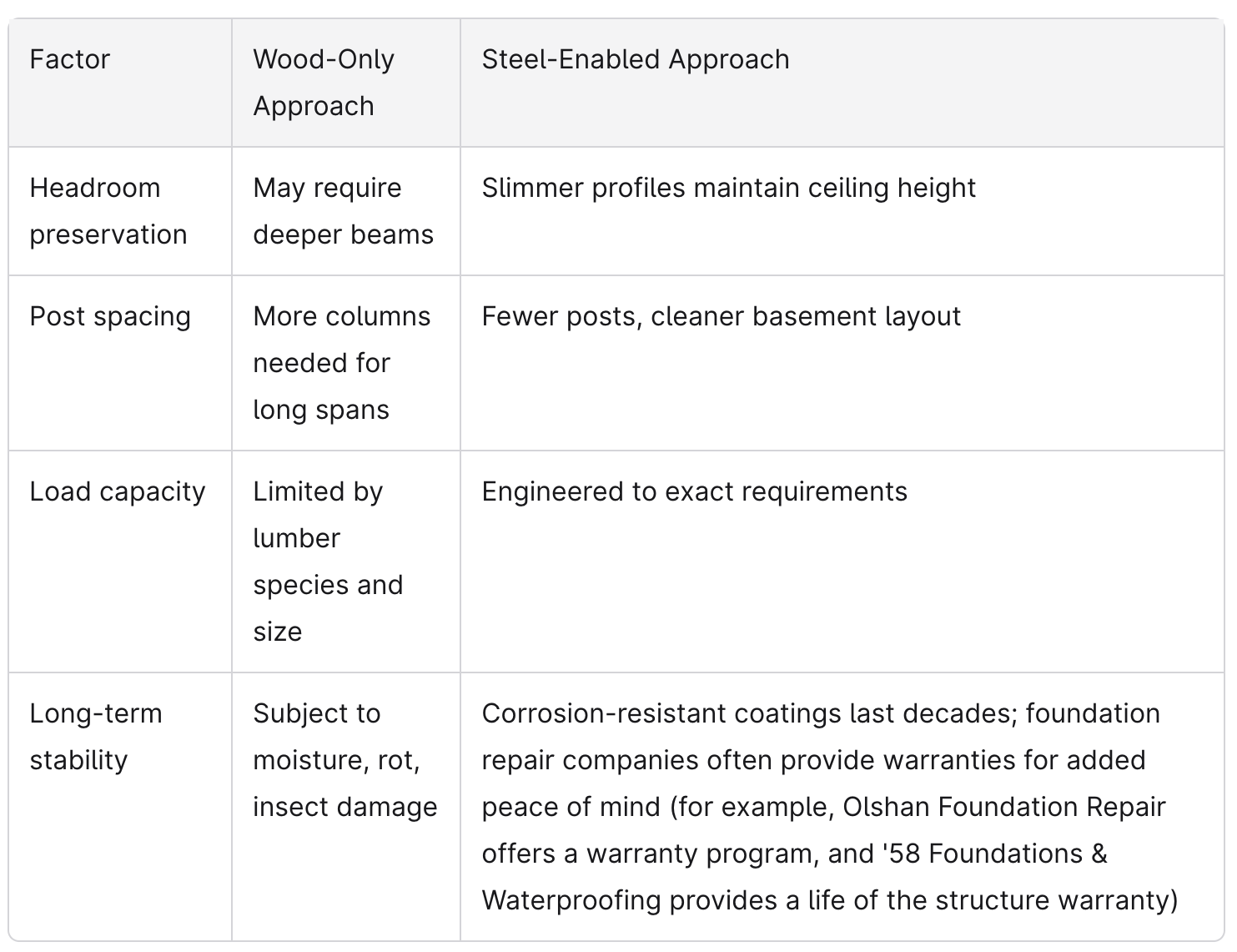
Corrosion-resistant coatings last decades; foundation repair companies often provide warranties for added peace of mind (for example, Olshan Foundation Repair offers a warranty program, and '58 Foundations & Waterproofing provides a life of the structure warranty)
We apply appropriate corrosion-resistant coatings and proper detailing to protect steel in humid crawl spaces and basements, ensuring decades of dependable results. And we combine steel with engineered lumber and proper hardware—joist hangers, structural bolts, and connectors—according to engineering specifications. Nothing is improvised on site. For additional assurance, many foundation repair companies in Atlanta, such as Ram Jack with over 40 years of experience, back their work with expertise and warranties. Companies like AquaGuard also offer free, no-obligation inspections for foundation repair, demonstrating a commitment to customer service.
These upgrades increase safety and open up future possibilities. Want to remove a bearing wall for an open kitchen? Planning to finish a basement for multigenerational living? The structural upgrades we install today make those projects feasible tomorrow.
Protecting Historic Character While Repairing Sagging Floors
Atlanta’s historic and older neighborhoods contain homes worth preserving—not just for their resale value, but for their architectural character and the quality of materials no longer commonly available. Heart pine floors, original plaster walls, period-correct trim, and handcrafted details deserve structural repairs that protect them rather than destroy them.
Our preservation approach:
We work primarily from below—in crawl spaces and basements—to correct joist and beam issues without stripping original floors, trim, or plaster whenever possible. The structural work happens out of sight, leaving the living spaces above largely undisturbed.
Gradual re-leveling is essential for historic homes. Sudden jacking movements can crack vintage plaster walls, misalign original windows, and damage irreplaceable tile. We apply pressure incrementally, allowing the structure to adjust without traumatic shifts.
We coordinate with homeowners’ preservation priorities. If keeping original heart pine floors, matching period-correct trim, or preserving exterior façades matters to you, we design our access points and repair sequences to minimize visible impact. The goal is structural integrity beneath beautiful, authentic surfaces.
Benefits beyond preservation:
Structurally sound joists and beams actually make future preservation work easier. When the floor system is stable and properly engineered, designers and trades can upgrade kitchens, baths, and mechanical systems without worrying about foundation problems or inadequate framing undermining their work.
Engineering-Led, Minimally Invasive Process Homeowners Can Understand
Our philosophy ties together clear diagnosis, engineered design, and construction that respects your home and your routine. We believe homeowners deserve to understand what’s happening under their floors and why each repair step matters. Our service is built on professionalism, transparency, and a commitment to customer satisfaction throughout every stage of your project.
Our typical service process:
Consultation: We discuss your concerns, the symptoms you’ve noticed, and any renovation plans you’re considering. This helps us understand what you need from the structural assessment. The best way to find the average cost of foundation repair is to schedule a free, no-obligation evaluation—our service includes this as a first step.
On-site inspection: We physically examine your crawl space or basement, documenting joist conditions, beam deflection, column placement, moisture levels, and evidence of prior repairs or alterations.
Structural analysis: For straightforward repairs, our team applies proven solutions based on decades of combined experience. For complex cases, we coordinate with structural engineers to model loads and specify materials.
Written plan and closed-scope quote: You receive an itemized proposal showing exactly how many new footings, which beams or joists are being strengthened or replaced, what materials we’re using, and what’s included in cleanup and restoration. No vague allowances or open-ended estimates. We believe in cost transparency—note that waterproofing costs often vary by a greater margin compared to leveling a concrete slab or sunken crawl space, so your quote will reflect the specific service your home requires.
Scheduled repair work: We execute the installation process according to the plan, communicating any findings that arise and addressing them within the agreed scope.
Final walkthrough: We review the completed work with you, explain what was done, and confirm the repairs meet your expectations.
We walk homeowners through diagrams or photos so they understand the repair logic. When we coordinate with other renovation work—kitchen remodels, load-bearing wall removals, basement finishing—the structural repairs slot smoothly into the larger project plan.
Our goal is stable, quiet floors and peace of mind—not upselling foundation repair services or products you don’t need.
How Proper Joist Repair Improves Safety, Comfort, and Home Value
Done correctly the first time, sagging floor joist repair delivers lasting solutions that affect daily life and long-term investment.
Safety improvements:
Reduced risk of sudden localized failures where joists have cracked or rotted through
Better performance in heavy-use rooms like kitchens, laundry rooms, and bathrooms
More reliable support for heavy fixtures, appliances, and furniture
Elimination of makeshift “temporary” supports that may have been in place for years
Comfort improvements:
Fewer squeaks, creaks, and vibrations when walking across rooms
Level surfaces that let furniture sit flat and doors operate smoothly
Less “bouncy” feeling underfoot, especially in older homes with long joist spans
Uneven floors corrected, reducing the sense that the house is shifting
Financial and resale value:
Professional structural repair with documentation reassures buyers, appraisers, and inspectors
Avoids price reductions due to visible sagging or unsupported alterations
Demonstrates responsible maintenance that protects property investment
Addresses foundation issues and structural damage that could otherwise derail sales
Solid framing makes future renovations more straightforward and less risky
Homeowners can invest confidently in additions, basement conversions, or major kitchen overhauls
Load-bearing wall removal becomes feasible with properly engineered support already in place
Reduced likelihood of major structural surprises 10-20 years down the road
By eliminating moisture-related deterioration and under-framed spans, you protect your home from the compounding damage that makes structural work increasingly expensive over time.
Preventing Foundation Damage: Proactive Steps for Atlanta Homeowners
Protecting your home’s foundation is one of the smartest investments you can make as an Atlanta homeowner. The unique combination of Georgia’s red clay soil, frequent heavy rainfall, and the age of many homes in the Atlanta metro area means that foundation problems can develop quietly but quickly—often before you notice visible signs like cracks or uneven floors.
Why prevention matters:Foundation damage doesn’t just threaten the structural integrity of your home; it can also lead to costly repairs, lower property value, and even safety concerns for your family. By taking proactive steps, you can avoid the stress and expense of major foundation repairs down the road.
Practical ways to prevent foundation damage in Atlanta:
Manage water around your home: Ensure gutters and downspouts direct water at least 5-10 feet away from your foundation. Regularly clean gutters to prevent overflow, and check that the soil slopes away from your home to reduce hydrostatic pressure against basement walls and crawl spaces.
Control moisture in crawl spaces and basements: Install vapor barriers, sump pumps, or dehumidifiers as needed to keep these areas dry. Excess moisture can weaken support beams, encourage mold growth, and accelerate wood rot—all of which undermine your foundation’s stability.
Inspect for early warning signs: Walk your property regularly and look for wall cracks, sticking doors, or new gaps around windows and floors. Catching these symptoms early can help you address minor issues before they become major foundation problems.
Maintain landscaping thoughtfully: Avoid planting large trees or shrubs too close to your foundation, as their roots can disturb the soil and concrete slabs. Keep flower beds and mulch at least a few inches below siding to prevent moisture from wicking into your foundation.
Address plumbing leaks promptly: Even small leaks under slab foundations or in crawl spaces can erode soil and cause foundation settlement over time. If you notice unexplained moisture or higher water bills, investigate immediately.
Schedule periodic professional inspections: A trusted foundation repair company familiar with Atlanta’s housing stock can spot subtle signs of foundation damage and recommend preventative measures tailored to your property.
By staying vigilant and addressing potential issues early, you can help preserve your home’s structural integrity and protect your investment for years to come. Proactive maintenance is always more cost-effective than waiting for foundation problems to escalate—giving you peace of mind and a solid foundation for whatever the future holds.
Ready for Clear Answers on Sagging Floors? Schedule a Free, Closed-Scope Quote
If your floors sag, bounce, or slope in ways that concern you, the right response isn’t to ignore it or accept surface-level fixes. The right response is to get clear answers from a skilled team that specializes in sagging floor joist repair and comprehensive foundation repair solutions. It's also crucial to understand how choosing the best subfloor materials can impact your home's flooring stability.
Heide Contracting is a company that focuses on structural renovation—crawl space joist repair, basement joist and beam repair, load-bearing wall changes, foundation repair solutions, and waterproofing across our service area in the Atlanta region. We specialize in these services every day. We’re not a general contractor dabbling in structural work; we’re specialists who understand how Atlanta’s older homes were built and how to make them sound for another generation.
Our evaluations are free. Our quotes are closed-scope and itemized, so you know exactly what you’re approving and why. No surprises, no pressure, no vague estimates that balloon once work begins.
Contact us by phone or through our website to schedule an on-site visit. We serve homeowners throughout our service area in metro Atlanta—including Decatur, Sandy Springs, Marietta, Roswell, and surrounding suburbs. Check if your location is included in our service area. Whether your home is a 1920s bungalow, a 1960s ranch, or anything in between, we can assess what’s happening and provide a comprehensive repair plan that addresses root causes, including risks like water damage and the need for waterproofing to prevent future issues.
Don’t wait for floors to get worse before seeking an opinion. Delaying repairs can lead to water damage, mold, and more costly structural problems. An early, engineering-led assessment can stabilize your home, protect its character, and support whatever you want to do with the space next. Reach out today for a free estimate and the peace of mind that comes from working with a trusted foundation repair company that treats your home’s structure as the interconnected system it truly is.
Choose a company that specializes in foundation repair solutions to protect your investment.